

While many are worried about AI bubbles and races, U.S. grids, energy and infrastructure are getting a real-time makeover. The recent Meta announcement to add 6.6 GW of nuclear capacity to support its AI supercompute campus Prometheus in Ohio and other data centers is a sign of the times. Since then, more have followed.

While AI workloads and dense compute dominate headlines, the shapeshifting growth of the digital economy is part of the larger story too.
This first big wave of AI compute is spreading around the U.S. and globe, and others will follow. While energy is integral to the speed of the AI infrastructure build out, the physics of energy and pace of physical infrastructure development are the moderators of it. Others in the industry call them the ‘governors,’ which is more interesting.
The technology of AI is ‘unoptimized’ as D.C.-based chief technology officer Dan Golding of advisory ASG notes in my recent work.[1] Evidence of varied use cases by consumers and businesses, whether generative AI, machine learning or other forks in the road of AI tech, are emergent, fluid, and building a momentum that is hard to describe—around the globe.
While AI infrastructure is dependent on energy, the technology’s fluidity means linear conclusions about energy demand are out the window as the Meta announcement shows. This will be a step-change process. An infrastructure stock change is being pushed by the innovation inherent in more dense compute power. Meta’s 20-year deal with Dallas-based utility Vistra, extending nuclear fleet lives and expanding capacity in the PJM grid, a 13-state region plus D.C., is one example of a direct and practical bet to date. Included are next generation nuclear technology down payments in firms Oklo and TerraPower, too.
U.S. grids and the energy resource mix status-quo are changing.
Tale of two grids
On the concern side of the ledger, forecasting real data center demand is also vital when adding new transmission, generation and the heavy lift of AI data centers. A University of Southern California (USC) study forecasts 50GW of planned data center capacity to 2030, with 5GW in Texas and 19 in Virginia, based on colocation and hyperscale developers, the bulk of new builds.[2] In June 2025, Texas grid operator ERCOT counted 4.6 GW ‘energized” plus 2 more approved for 2026, with planning study approvals of 12 GW to 2030.[3] Like Northern Virginia, Dallas is a “Tier 1” market for data centers. The Texas Triangle — Dallas, Austin and San Antonio, and Houston—is becoming one massive cloud node.
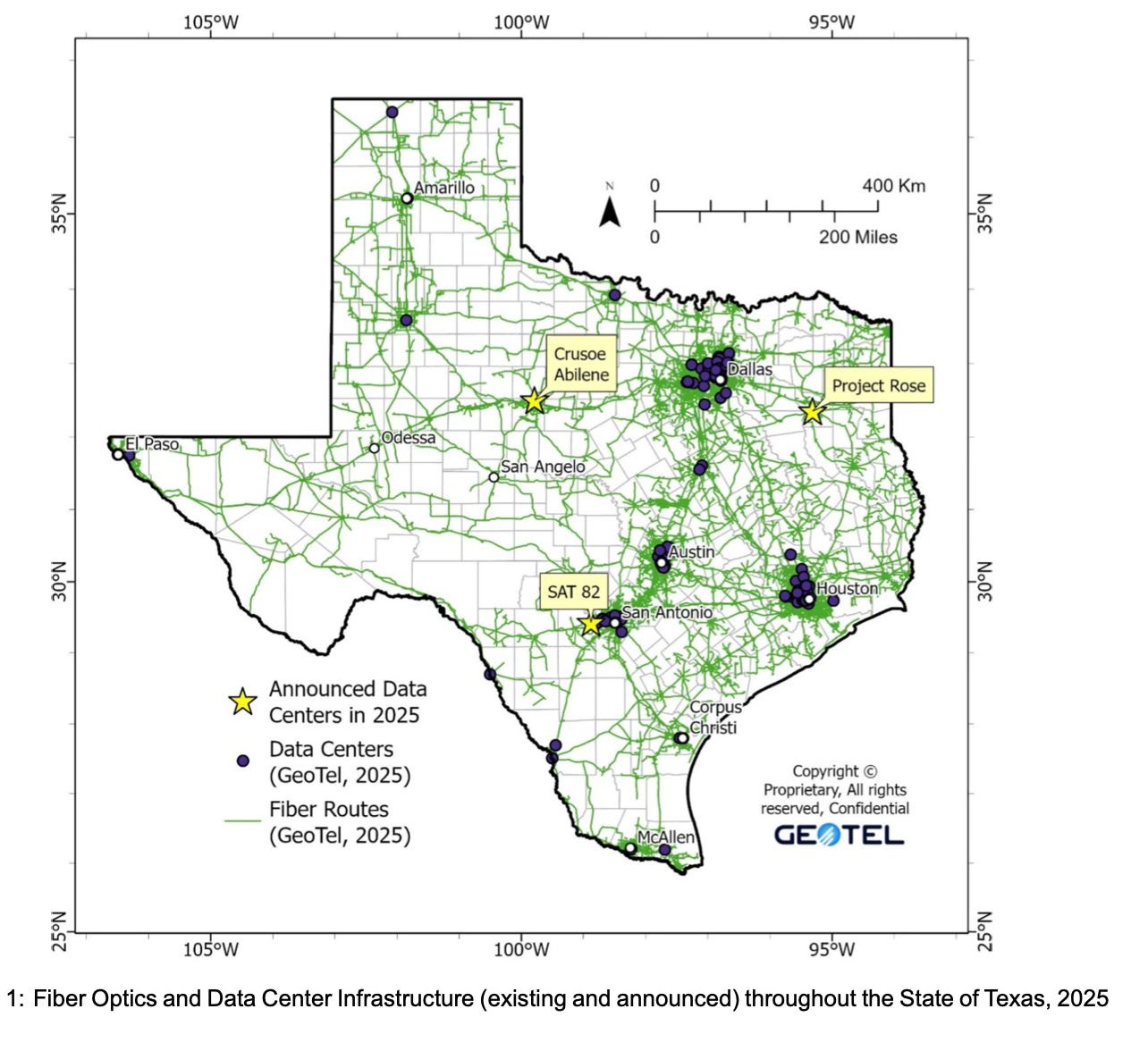
More large-scale data centers are coming to Texas, with its own ERCOT grid, and PJM, home to data center alley. PJM once expected 30GW of peak load growth to 2030, in line with the USC study. However, from a recent AI conference at the Federal Reserve Bank of Dallas, we learned that PJM is recalculating their forecast. Comparisons to Virginia, Texas or other emergent clusters are apples to oranges, as is the same with energy and grid systems comparisons.
Most grids have been largely enabled to handle the super peak, which rarely happens –like 1 to 2% of the year, noted a Vistra executive recently. That speaks to PJM’s approach of a capacity market versus Texas’ competitive market. The grid -- the thermal fleet of gas, coal, nuclear—runs on average 40 to 50% of the time. Incidentally, Burke recently mentioned that Texas could handle 10GW of data center demand without new generation.[4]
The concerns about increases to electricity prices are complex based on grid region, resources available and legacy policies. Both Texas and PJM, plus other regional grids, are adding new high-voltage transmission to synch up energy resources to expected demand centers. Meta and other hyperscalers have recently pledged to be accountable for their own power consumption and not burden ratepayers. Big Tech is giving the U.S. grid a facelift.
Catching the wave
A competitive energy market, ERCOT has been experiencing growth for the last two-plus decades and PJM has not, with it even hitting new peak demand records. Between the deindustrialization and energy efficiency that’s occurred in PJM’s past, which includes a now- changing Rust Belt, PJM hasn’t had to worry about resource additions. In November 2025, the Vistra executive forecast load growth in PJM of 2-3% and Texas at 5-6%.
A sign of these “reindustrializing” times, Vistra just added 5.5GW of natural gas generation assets, with nearly 60%, heading to Pennsylvania, Maryland and New Jersey, PJM’s original namesake states. Excess capacity exists on the ERCOT grid at 160 GW of nameplate capacity[5]. The price signals of Texas’ competitive market seem to be working in this demand-driven environment, optimizing supply which can deter overbuilding assets.
From 85GW peaks of the last two Texas summers, Vistra’s expectation in July of 2025 was 105-110 GW of load growth by 2030, with the expectation that large loads curtail their usage off-grid during the peaks. Without curtailment, more generation would be needed. Burke suggested that ERCOT expand its gas generation utilization like PJM does, from say 50% to 70%, thus adding more capacity. For a hot summer’s reference, U.S. peak electricity load reached 760 GW in 2025, and PJM’s peak load count was 161 in June 2025.[6] More nuanced approaches are happening with large loads exercising their choice of siting based on market capacity and attractiveness.
Interestingly, at the Dallas Fed conference, according to Enverus’ Johnson, power is a big problem across grids, with ‘bottlenecks everywhere.’ Given U.S. installed capacity, solar, natural gas and batteries will be called on more immediately. This dynamic has been building, but that confirmation from a group that sees the entire U.S. energy system is instructive. She also noted that the grids of SPP and MISO are more advanced in solving their interconnection queues relative to PJM and ERCOT. However, the work is being done by these very large, load-attracting grids.
Better resource utilization and new approaches are being forced by the market to meet a multi-generational infrastructure pivot. In a reindustrializing era, more robust ERCOT and PJM grids are possible. AI infrastructure, and the technology driving it, may just push U.S. power and grids for the benefit of next generations.
[1] https://www.dmagazine.com/publications/d-ceo/2026/january-february/ai-power-race-crosby-marsh-schaap-cummins/
[2] “Data Center Energy Demand: Who, Where, and How Growth Is Emerging,” Shon R. Hiatt and Angela Ryu,
University of Southern California, Marshall School of Business, Sept 2025.
[3] ERCOT Large load report, June 2025. p 9.
[4] https://www.dallasfed.org/research/swe/podcast. See “Can Texas Muster the Power…”
[5] See “New Texas Energy Barons”
[6] https://www.eia.gov/todayinenergy/detail.php?id=65864#:~:text=Hot%20weather%2C%20which%20increases%20electricity,Texas%20and%20in%20Northern%20Virginia.