

Power is where the AI buildout gets real. Many of the headlines about AI are snippets. The real constraint on compute is power, and power is what solves it. In the November D CEO energy edition, I tell the tale of that story through two features: one is a profile of Vistra and its CEO Jim Burke, who received the Legacy Award at a recent energy awards event. An accompanying trends piece features Applied Digital CEO Wes Cummins. Both are Dallas-based chief executives solving power challenges in the AI buildout.

Myths are circulating in the ether that energy demand is explosive. Burke notes that electricity demand is growing roughly 2 to 3% a year. Another overstated statistic is the widely cited 400-plus-gigawatt Texas queue for large loads, of which is 90% data centers. This absolutely will not be built. Burke sees more like 12 to 15 gigawatts through 2030, possibly 15-20. This may happen beyond 2030, given the Texas audit and therefore potentially slower pacings depending on the election outcome. Interconnection queues need to be sorted to identify real projects, and both the PJM and ERCOT grids are working towards this in their own ways.
According to my work, Vistra saw the need for “dispatchable” or firm baseload early. In 2018, when the conversation was all about renewables, Vistra bet that firm, dispatchable base-load power would be needed. It bought undervalued gas plants (adding almost 20 gigawatts with the Dynegy acquisition) and invested in nuclear well before Amazon’s Susquehanna deal woke up the power industry. It’s market cap grew from roughly $10 billion in 2017 to about $47 billion at the time of print. Burke, at the company 25 years, has paralleled the Texas market’s competitive and deregulated landscape also for 25 years.
There are many paths for greater efficiency in grids ahead. Vistra operates in both PJM and ERCOT, the two largest U.S. markets. Its mantra is to use existing assets more smartly—the grid is only about 35% utilized, according to Burke. Vistra has extended the lives of several nuclear plants around the country. Grids are built for summer peaks, but winter peaks are increasingly a source of grid challenges. Batteries and renewables help, but batteries cannot cover a multi-day winter storm, so firm power remains essential. The goal is to power AI reliably, affordably and efficiently.
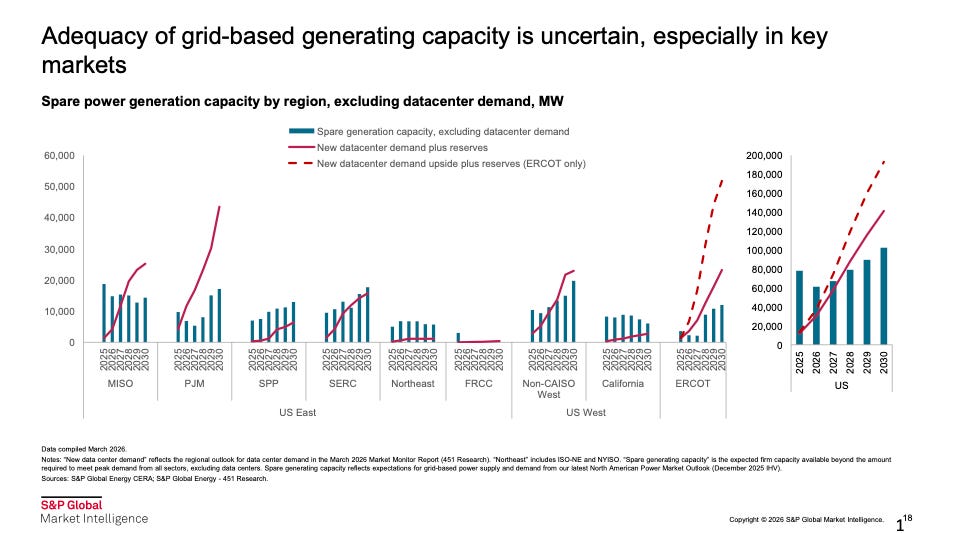
Adding large loads can actually lower ratepayer costs, which is an underreported angle. Hyperscalers are less price sensitive than past industrial customers, so grid upgrades are happening on the back of hyperscaler capital spending. These large loads are paying for infrastructure upgrades; they also help spread fixed costs across ratepayers over time with their additions, potentially reducing costs. With Vistra’s generation fleet, Meta and Amazon are paying for nuclear fleet extensions, giving ratepayers carbon-free attributes that would not otherwise exist. This rarely shows up in the headlines.
The Texas market is a proving ground for the AI buildout. It is also the most competitive energy market in the world, with long experience in co-location approaches, for example, pairing a power plant with an industrial asset such as a petrochemical plant or data center. Regarding the idea of flexible loads, an approach needed ahead, Texas’ bitcoin miners curtail their energy usage during grid emergencies or in response to higher price signals. To deliver speed to power, behind-the-meter builds, a more expensive option, are also emerging. Most of these designs, funded by hyperscalers or investors, will ultimately be added to the grid.
In light of the moratoriums proposed, grid-connected assets appear the way to build. Still, one-sized approaches and prescriptions do not suit every case and every locale. The market and the public like the simple answers. They do not exist in such as complex tie-up between energy and digital infrastructure.
The market is still conflating long-lived assets versus an asset-light mindset inherent in the hyperscaler’s former life. Power plants tend to last 30 to 50 years, and digital infrastructure is also long-lived. Big tech is used to asset-light models and is now bumping into heavy infrastructure spending, which helps explain market volatility and a misreading of the play. Infrastructure firms and big finance are entering the market and may be the eventual owners of these assets in the future as well. A Blackstone REIT and hybrid infrastructure solutions characterize the new day. Some of the reactions about debt financing and neocloud constraints circle this dynamic.
Capital Recycling in AI Infrastructure

In a video analysis, I discuss how capital is moving through the data center space. A few highlights below:
Hyperscale capex has been a major support for U.S. GDP. Top hyperscalers will spend over $800 billion in 2026, but thus far 2027 spending looks higher. Peak spending could come around 2028. None of this changes the impact of the AI boom, just where the revenue and costs shift. In the next 3-5 years, a baseline will emerge. In the last year, the different paths of hyperscalers, and the disruption therein, has become clearer.
Oil and gas, utilities and independent power producers like Vistra are integral to the AI buildout. Renewables and nuclear are being reupped in the mix too. The additional energy demand will require an efficiency-first mindset.