

Each day new storylines about the AI infrastructure buildout intersect and overlap. However, more data continues to support the buildout that is emerging. In new research from the white paper “What You Need to Know about the AI Buildout,” I highlight the way in which the technology is changing. This is integral to the conversation as bets are made.
One has to look at this buildout from many angles to power through the headlines and noise.
In published work early 2025 and 2026 about the buildout (below), I referenced the concepts about scale. Those ideas matter for this discussion to ground what is happening. Four forces are building atop each other:
the power of the Internet, with search changing;
mobile apps and mobility;
cloud infrastructure growth and changes;
AI technology bucket, which includes generative AI, machine learning, and many more technologies.

Technology’s Pacing
Importantly, the growth curves of each of the four are creating synergies yet to be determined. Nasdaq reports that the “AI industry” is pacing three times faster than the top three buckets noted above. The expansion of token volume is a proxy for this growth.
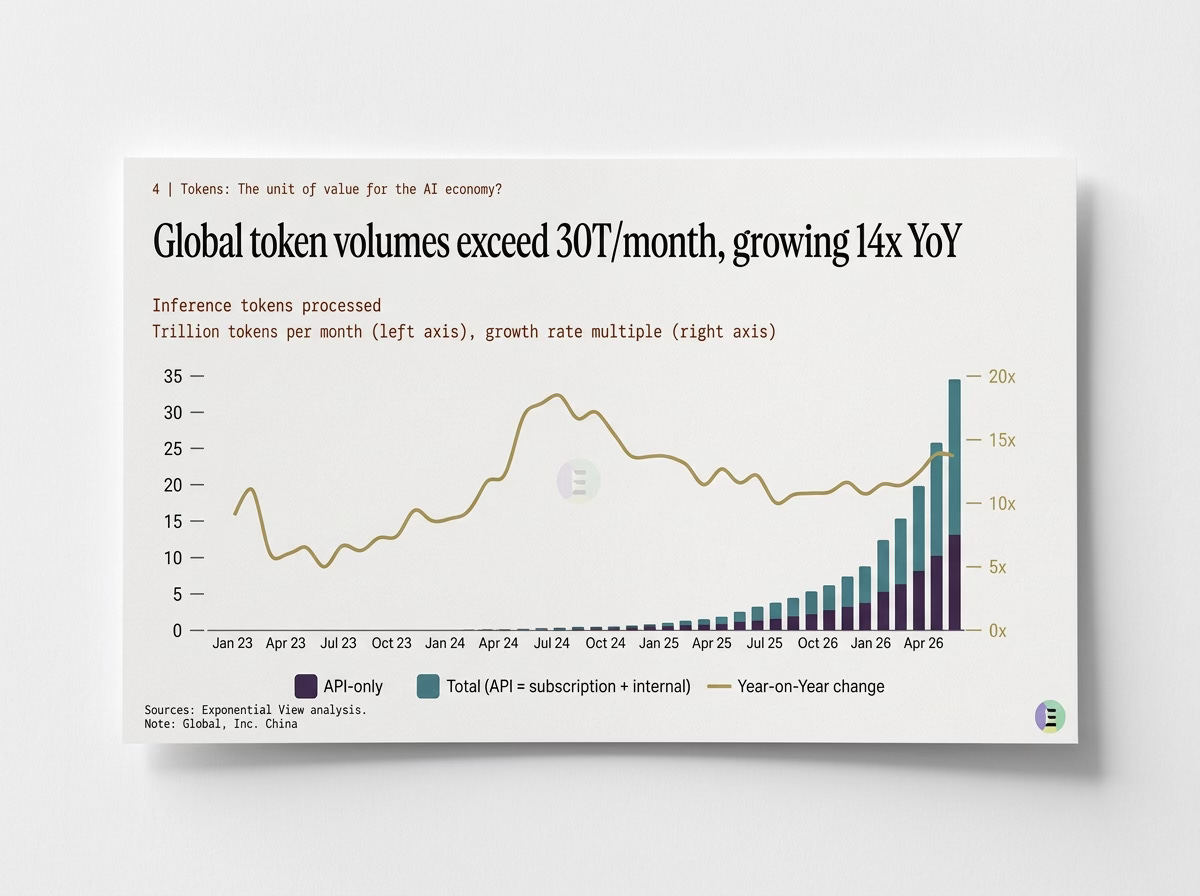
In the chart, note that “API-only” is developer use. Most tokens were largely in training output before early 2025, i.e., inference wasn’t on the books just yet.
Whether a token is open- or closed-source, it still requires the same chips and associated infrastructure to produce, and in some cases, more. Models’ competition is fierce. Nasdaq says:
The biggest risk to further upside resides with the closed-model frontier players, their ability to remain at the frontier preserves their pricing power, as more and more open-source-powered AI agents proliferate and require ‘higher IQ’ teachers, coordinators, and supervisors to help them deliver value-add.
Closed models are like Anthropic’s Claude and OpenAI’s GPT-4 and 5. We know various hyperscalers have developed their own too, Google’s Gemini (closed), Meta’s Muse, and others, etc. Amazon uses many via its cloud offerings, including its own proprietary model, Nova.
This is a work in progress, hard to parse, as announcements from the players in the data talk their book.
Agentic AI and tokenomics are a storyline left for another day, but an indication is ahead. According to Goldman Sachs, token use by AI agents is forecast to grow 24x by 2030. Importantly, frontier models determine what tokens should come next. The infrastructure, and specifically memory bandwidth, determines how fast and how cheaply those tokens can actually be produced at scale.
Increasingly, the use of AI technologies is becoming highly embedded in fields beyond the hyperscalers, though they are top users and builders. Even academic research is pushing boundaries and asking questions about the technology’s effectiveness. It’s all new terrain. There will be breakthroughs and failures, but forward movement ultimately.

Select Chip and Digital Infrastructure Dynamics
Some of the “obsolescence of chips story” of fast depreciation is changing. Chips are responding to intellectual property enhancements, such as software upgrades, helping extend their productivity over longer time horizons. Operational innovations are emerging to optimize the mix of chips, networking, power flow, and cooling to squeeze out the maximum possible yields. Data center developers, including those that shifted from bitcoin mining, are innovating in the operational space and identifying new business models. Three distinctive business models have been identified that are proving profitable, but this is a moving target too.
In a recent interview with a developer executive, he confirmed that roughly 75%–80% of the spending on a compute GW is the IT equipment, chips, and networking. The remaining 20% is the land, shell, and related heating and cooling infrastructure. However, as we know, increased memory chip constraints have raised prices, with numbers cited of 15–20%. Top memory chipmakers Samsung and SK hynix raised HBM3E supply prices by nearly 20% for 2026. Even Apple had to raise prices owing to memory chips.
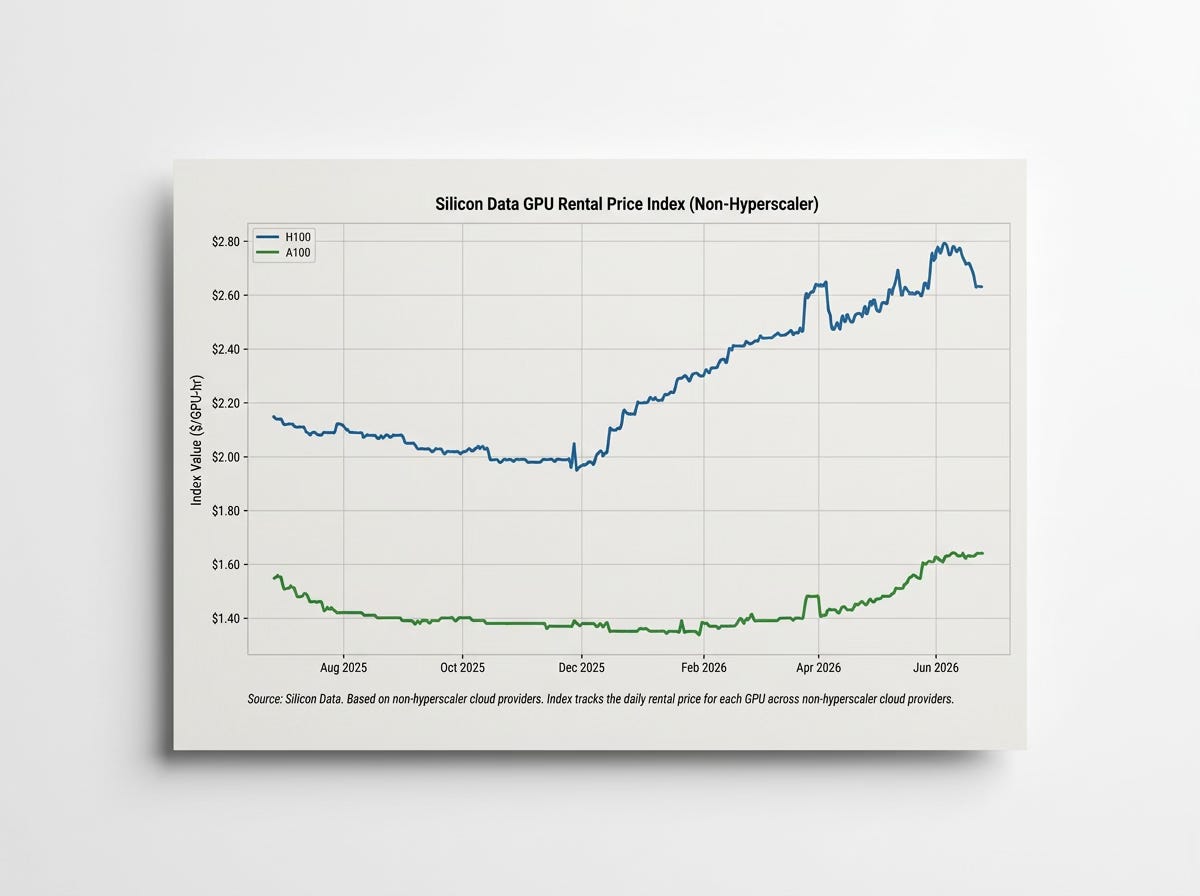
Still, optimization is continuing to increase with each newer generation of chips sourced into the data center market. Below H100s, the blue line is newer chip generations than A100s.
Meaning Through Chips Layer
Further evidence beyond Nvidia comes from rival Broadcom, with a focus on custom silicon. From a recent earnings call, they project ~30 GW aggregate demand across six customers (Google, Anthropic, OpenAI, Meta, Microsoft, and Amazon), translating to a $350B two-year shipment commitment. Interestingly, the dollar content per gigawatt is stable at $20–30B across generations of their offerings. Chips are becoming more powerful, and growth is resulting from more gigawatts deployed, not price expansion. While Broadcom expects to ship $350B in goods, deployment of those chips have their own timing.
Custom silicon, like ASICs and XPUs, are evolving from a niche hyperscaler side project; Broadcom is positioning itself as a main actor in that shift.
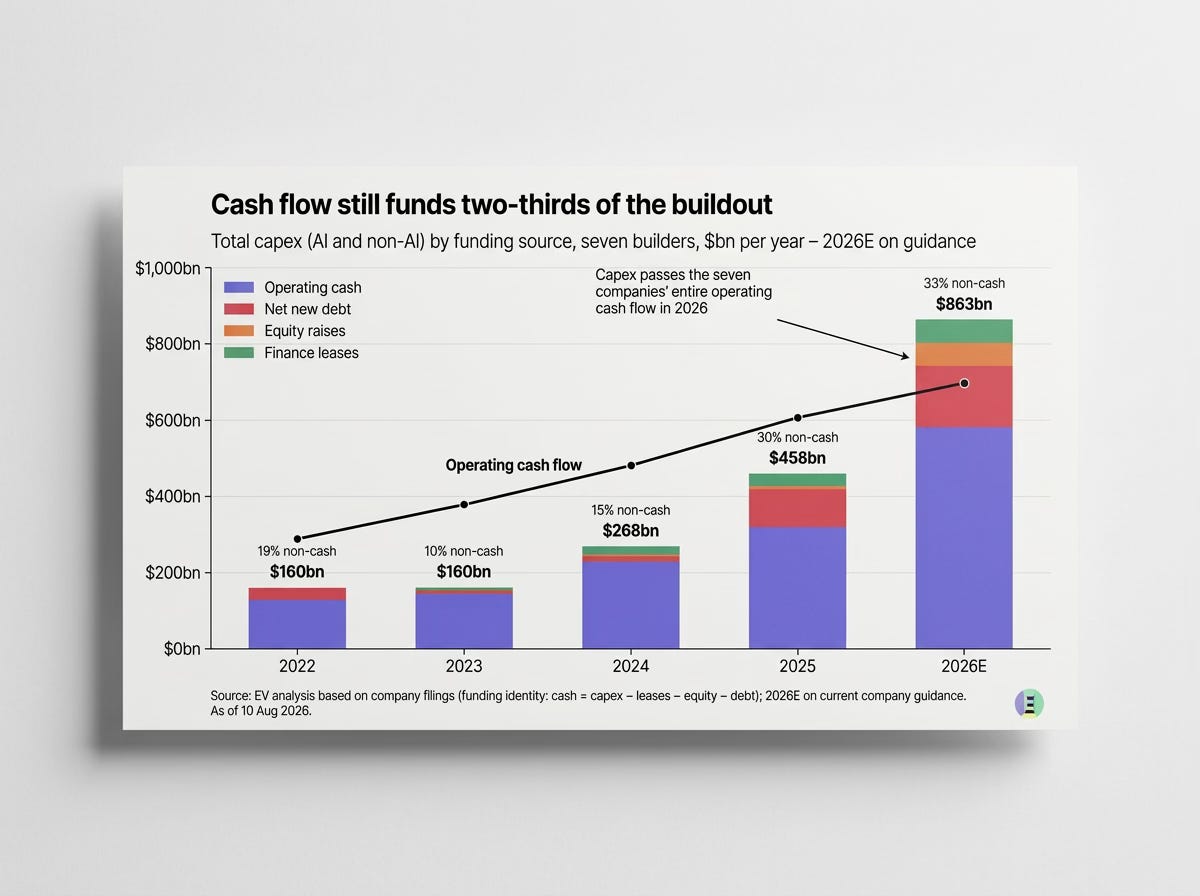
A timing mismatch exists in capex spending versus the payoff, with data centers requiring 18–24 months to build and sometimes longer to energize. We know more debt is being issued for the buildout, but that was inevitable.
As Fed Chair Warsh notes:
Will we see a sustained rise in productivity across the economy, and when? Will next-generation models demand more capital, or will models themselves enable a more capital-light path? It’s still unclear where returns on capital will land, and when.
— From Chairman Warsh’s Jackson Hole speech, Aug 28, 2026.
However, as I noted previously, he calls on market participants to inform the debate. This is the role of markets and investors, plus other information intermediaries.
Video clip from 22-minute white paper video walk through and extra economic analysis
Recent Data on Key Areas of Spend
From Federal Reserve data, the 2025 totals for the proxies of the AI buildout (minus software) are:
Data center construction: ~$49.7B for the full year
Computers/peripherals: ~$270.7B for the full year
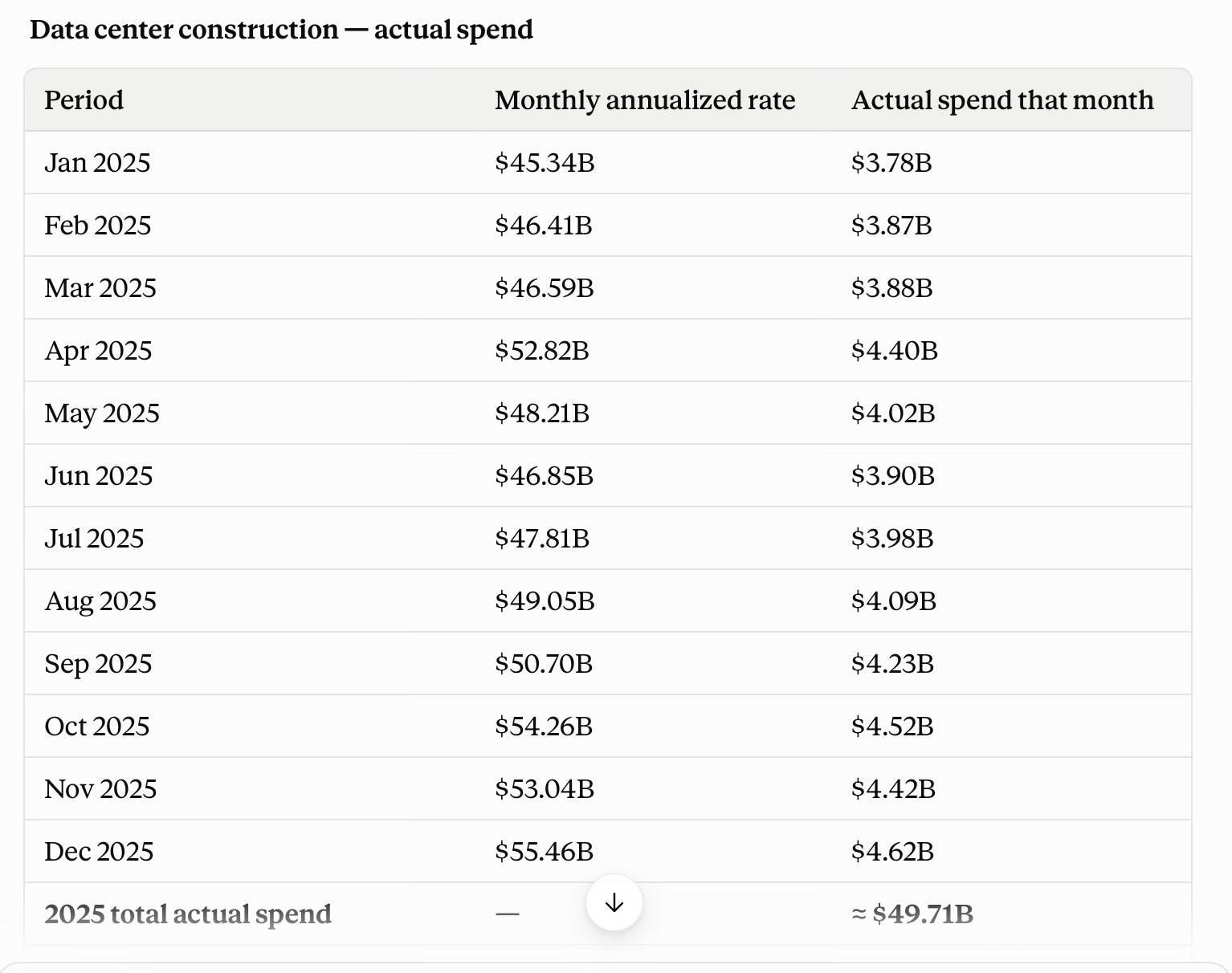
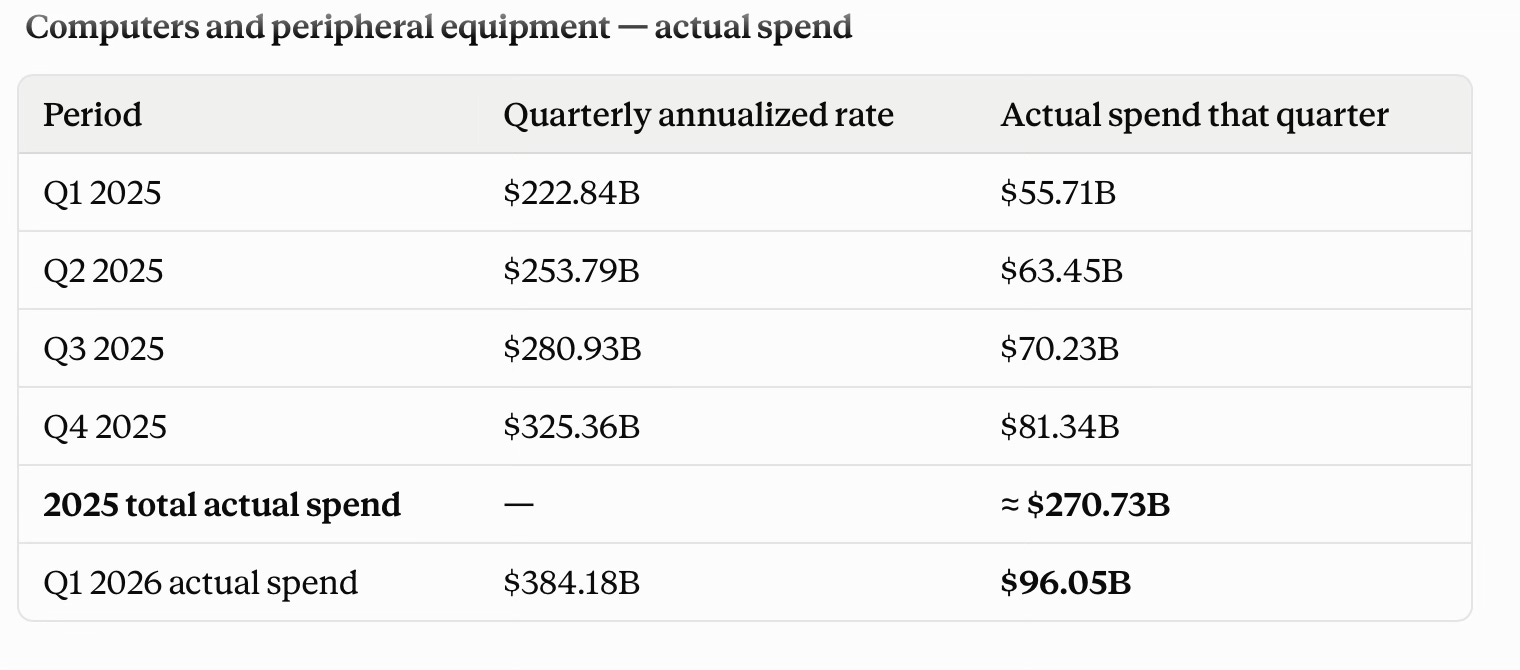
Furthermore, the U.S. imported $93.14B worth of computers alone in Q1 2026 — almost exactly matching the $96.05B total actual investment spend on computers/peripherals calculated from Bureau of Economic Analysis investment data. In other words, nearly all of that quarter's computer investment spending was satisfied by imports rather than domestic production, and only ~$16B was exported back out.
The AI trade has spread to virtually every corner of the market, though it is more concentrated in places. The white paper illustrates where some of the movement is occurring. This is a work in progress, hard to parse, as announcements from the players in the data talk their book. However, the trail is getting warmer.
Jan 2026
Portfolio: Inside the AI Power Race: Why DFW Could be the Backbone of the Next Industrial Revolution

The feature in the January-February 2026 edition of DCEO Magazine is a sequel to the March 2025 feature “The Really Wild AI Ride.” That feature represented about two and a half years of work focusing on what was happening with generative AI, semiconductors (chips), the emergence of more data centers and increased capex spending by big tech.
March 2025
Portfolio: The Really Wild AI Ride

In this early AI infrastructure breakout feature, the research behind the story began in earnest in May 2023.