

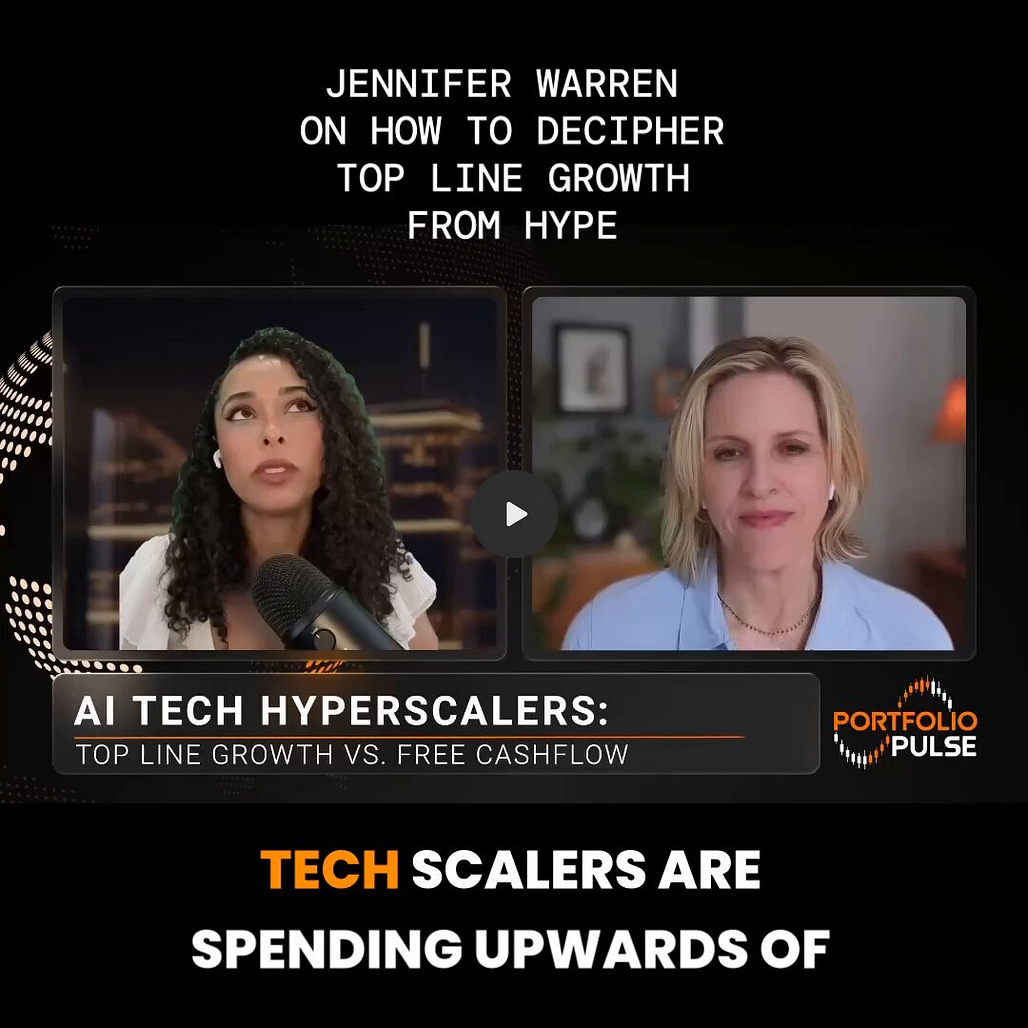
On June 14th, podcast host Nicole Benjamin of Seeking Alpha, the crowd-sourced financial platform, interviewed me about the concept of “MANGOS,” a modern successor to the FANG acronym. FANG captured Facebook, Apple, Netflix and Google. MANGOS captures the dominant players in big tech and potentially AI:
Meta, Microsoft
Apple, Amazon, AMD, Anthropic
Nvidia
Google
OpenAI, Oracle
SpaceX


[Shorts after interview text]
The Q&A follows, with more detailed elaboration.
Nicole: In your latest article of June 4th, you coined the acronym ‘MANGOS,’ grouping major tech firms (Meta, Microsoft, Apple, Nvidia, Google, Oracle, OpenAI, SpaceX) with AI infrastructure models like ChatGPT and Anthropic. With these private companies hitting the public markets with multi-billion-dollar valuations, how can investors distinguish true long-term value from headline hype? And what was the genesis of the MANGOS?
JW: First, you have to sort through what the big tech firms do. What is their source of value creation? And then, the AI frontier models, they’re new entrants. We don’t have complete information on their future, but we do know who is making revenue, presently. And we also know that the top big tech firms, the top of MANGOS, they are spending, on and investing in these frontier models like OpenAI and Anthropic.
So they’re more integrated into Big Tech’s business. Investing in AI frontier models, while there are huge valuations in some of these potential IPOs, this is only going to sort out over time. There are unknowns in the present.
One strategy is to just hold some of the various indexes that contain big tech and then what’s coming. Oracle’s kind of interesting too because they’ve been known for enterprise and a software provider, but they’re moving into cloud infrastructure and AI infrastructure an evolving area. And NVIDIA, known for their GPUS or chips, and the CUDA software stack, which is huge—for everything. They have the data center focus as well.
You have to do some of your own due diligence and be objective about the various firms about what their offerings are and make educated guesses.
[Interview derived from June 4 investor version Seeking Alpha or this Substack below]

Nicole: Big Tech and the hyperscalers are spending upwards of $700 billion on data centers and AI infrastructure. What specific indicators prove this spending is fueling top-line growth rather than depleting free cash flow?
JW: Part of this demand is the increase the cloud compute. And a portion of AI that’s going to be also in the cloud, that is high-performance computing., which uses GPUs, TPUs and other chips likes CPUs and more other custom chips. They’re part and parcel of the inference piece of AI, which is increasing, which is just using AI basically. [It also includes the use of agents and asking more of models.]
So we are creating this demand through our use of mobile phones, computers, internet streaming, anything data-related, manufacturing, businesses.
Everybody uses a data center of some sort to house their data. That’s part of it. More broadly, we’re using more compute and AI to do our work, and everybody’s doing it —businesses and consumers. So we’re creating this demand for AI workloads. But it has to be monetized.
We’ve heard that Google will be face a free cash flow squeeze and others are raising debt and equity. Much of this cap ex is to secure very costly chips and hard infrastructure to house their digital assets that are physical. If there’s no data center, there’s no cloud, and without fiber and connectivity, nothing happens. We’ve not had to think of the physicality of the data center really until recently.
Before we just thought about big tech in a lump. Now we call them hyperscalers; this has to do with their ability to their scale up compute, networks and storage across global networks. This scale is being reflected in a lot of this AI infrastructure development, a physical asset, which has to be energized. Now we’re going to have increasing energy/power demand owing to an increase in this digitalization for a period. It’s a very dynamic period [that will push energy forward in unique ways].
Nicole: You’ve noted that the AI revolution is shifting from a [general] software story to a physical power story. Why should investors consider allocating capital to energy and infrastructure assets instead of focusing solely on pure-play tech stocks?
JW: To be diversified, a portfolio needs to include energy and relevant infrastructure assets, plus even energy infrastructure, for example, midstream firms. They do kick off income, or, dividends, you know. I like to have basic necessary industries in a portfolio as a baseline of value and, hopefully dividends.
I don’t want to rely solely on growth or momentum, which can display volatility. So this is a preference for me. Initially, the chips story dominated the AI story, with NVIDIA, right, starting three years ago. Then frontier models, ChatGPT, and Claude were nascent until, like 2023, ‘24. The data center discussion really dominated late ‘24 through 25, which became the AI infrastructure story as folks recognized the appropriateness of it, this physical counterpart.
Freakouts, melt ups and downs have occurred along the way, and it’s not unwarranted. The numbers are staggering. In 2026, competitive advantages, strategies, and capex are in focus. Execution matters greatly now. The tech guys use the word orchestration. Many distinction and targeted strategies are more clearly focused with some big tech players, and AI cos. However, this disruption and shifting landscape will happen for the next several years.
Energy is a necessity to power these digital and physical infrastructure assets that are being built. They can’t operate otherwise, and there is competition for energy with other demand centers as well. The energy world has a lot of opportunity ahead, just powering the rest of the globe, plus securing sources that provide this firm mostly 24/7 power.
Nicole: Given the intense optimism around AI, how should investors filter out the noise to identify companies hitting operational targets versus those vulnerable to a reality check?
JW: So the headline hype is emotional and hard to tame. Investing requires reality checks through sorting through a firm’s operations, like I said early on. That is, how do they make money and what are their prospects, and the market’s expectations?
Both Open AI and Anthropic have revenue: $24 billion and $30 billion, respectively. Anthropic is profitable with free cash flow expected by 2027, according to projections. Open AI is profitable in 2030. [Google invested $900 million in SpaceX in 2015. The investment was worth over 100X in early trading of the IPO June 12th.]
Why my MANGOS metaphor works? It has some grounding in big tech, but acknowledges the opportunity ahead. Specifically, it captures AI frontier models but also an industrial aspect with SpaceX. Only time and market discovery will reveal what that truth is.
If you stock pick, consider both bull and bear thesis. Do your own research and learn how to discern fact from fiction over time. Have realistic expectations and don’t risk what you can’t afford to lose for a period. And have some strategy that incorporates a rising market overall, but targets areas where you have a natural or studied competency.
End of extended version interview.
[See an early 2026 feature about the AI Infrastructure buildout]
Portfolio: Inside the AI Power Race: Why DFW Could be the Backbone of the Next Industrial Revolution

The feature in the January-February 2026 edition of DCEO Magazine is a sequel to the March 2025 feature “The Really Wild AI Ride.” That feature represented about two and a half years of work focusing on what was happening with generative AI, semiconductors (chips), the emergence of more data centers and increased capex spending by big tech.

More research below.