

India is a really rich tapestry of people, places and bustling activity like no where on earth.


From a long-running history with India of 30 years, I’ll share some firsthand observations of the features of their growing four-trillion-dollar economy. It’s like a massive socio-economic experiment contained in the democracy, that is India. The numbers, however, do it no justice.
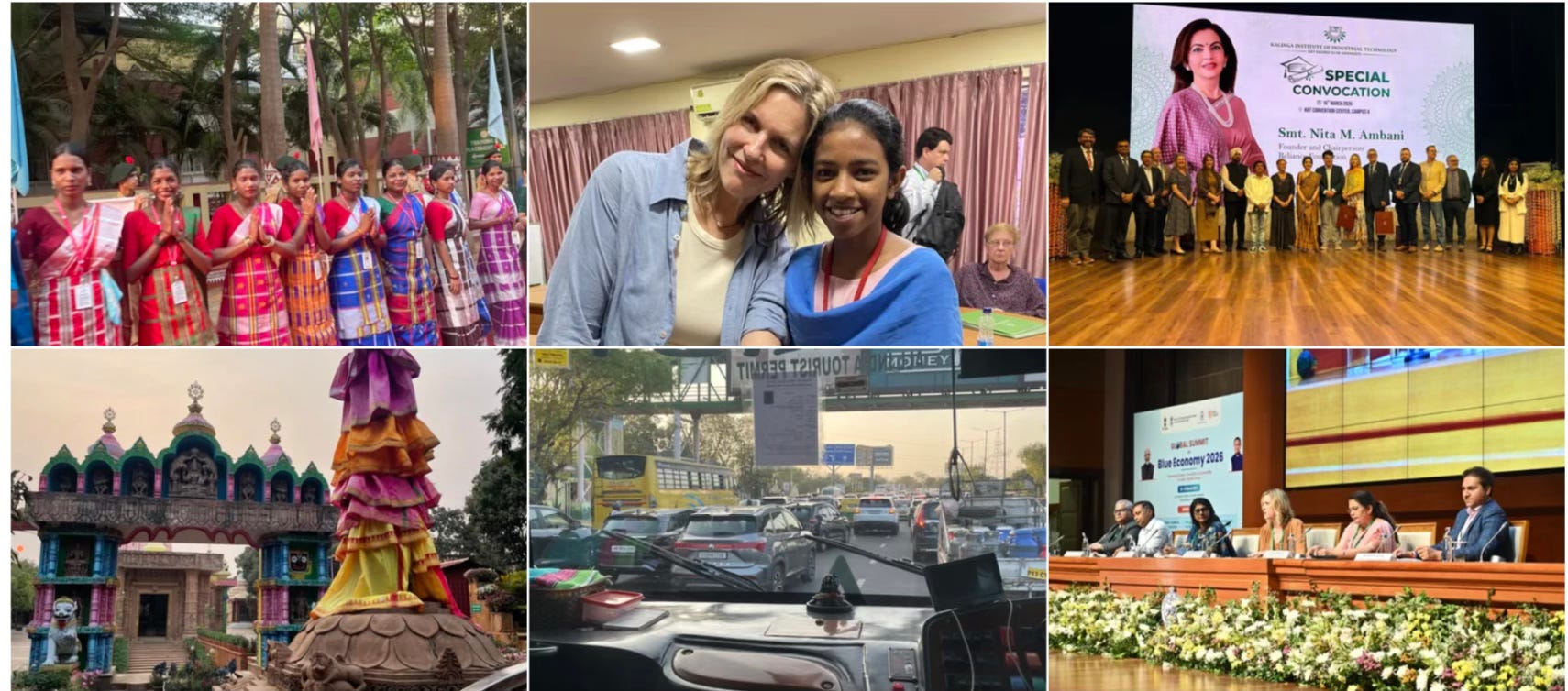
I was part of a delegation of educators, trade representatives, and creative professionals that left in early March and returned a couple of weeks later. Upon arrival, we spent two days in Delhi, then traveled south to Odisha — a growing state in southeastern India with a long 357-mile coastline curved along the Bay of Bengal. With the sea spray hitting my party’s faces, we marveled at just being there. The closeness of Southeast Asian surrounds was palpable, and its opening to the vast Indian Ocean.
As a maritime democracy, India’s history is interwoven with external relations and trade. We share that element with them, and also strong national identities.
Going back to a 1994 first trip to India, I traveled from Delhi north toward Tibet and Nepal, spending most of my time in the northern regions near the Himalayas, before heading south to Kerala at the southernmost tip of the country for a three-week journey. We were filming a documentary about a newly discovered cave called Patal Bhuvaneshwar.
India has developed enormously since then. Thirty years ago, I wrote a travelogue and so I have a detailed record against which to compare. At the Taj Mahal, the crowds were probably five to ten times what they were back then. This reflects the growing middle class we so often read and hear about — but from a first-person viewpoint. It depicts a new India that has more vacation time and disposable income to tour their own country, much as we do in the United States. Tourism is an agenda item for India in the future as well.


As the largest democracy in the world, we share many values with the people of India. As we celebrate 250 years of our experiment in democracy, their journey in independence began in 1947, after Britain left. We also share that history of freedom loving and independence. The young entrepreneurs with startups in clean coal production, ocean-related green ventures, and data science-based services spoke to an emergent India—and does not even scratch the surface.
Experiencing the young entrepreneurs’ stories was a window into the world’s largest democracy and top-five economy in transition.
In the last two decades, India has made great strides in their economic development, putting out the welcome mat to foreign investment in the early 2010s. Their tech capitals of Bangalore, Chennai and Hyderabad are well recognized and continue to attract U.S. big tech and global firms of stature. In the last year-plus, $70 billion in investment by Google, Amazon and Microsoft has been spent for data centers, according to the Ministry of External Affairs official we sat with in Delhi. However, the investment now goes bilaterally as well, a testament to the growing wealth of India.
[A 2008 analysis piece in Far Eastern Economic Review shows some early work about India’s infrastructure buildout.]
My state Texas has stakes claimed with India through many forms of exchange, whether in business or education. Recently, a first refinery built in half a century, in partnership with Reliance Industries, was announced. The $300-billion project by value, across a 20-year term, will process U.S. shale resources, which has been lacking since the onset of the twin booms in shale oil and gas. Reliance’s Ambani family has a refinery in India of similar size. In fact, we met with Ms. Nita Ambani, while she was recognized by the Kalinga Institute of Social Sciences in Bhubaneshwar, Odisha for her philanthropy throughout India.
A stadium of 40,000 students and officials from around the world witnessed an address that was cheered and revered. Ambani spoke of ethical, balanced leadership, its role in the global South, and women’s and girl’s empowerment. An honorary degree was conferred too by the affiliated Kalinga Institute of Industrial Technology.


The future plans and ambitions of India are notable. They are vying for the Olympics in 2036, with tracks being laid to advance their athletes competitive stature and the buildup of the infrastructure required as a foundation. One goal of the Olympics is socio-economic development for the country, a path which has been largely accomplished through education to date. A next iteration of the Indian economy is in the works.
The diaspora of India is notable and large, numbering over 5 million in the U.S. They also lead some of the most famous brands in America, with their stories of risk-taking, resilience and adaptability.
Top CEOs of Indian Origin in America
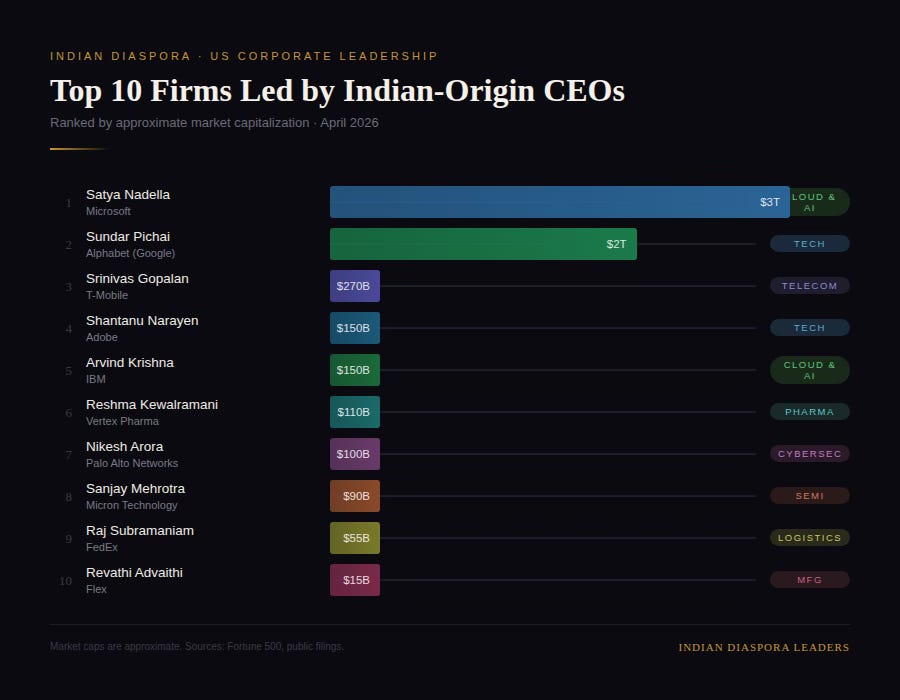
In the past, India was often thought of as bureaucratic and red-tape laden, a product of the state. While the most populous state may still have that aspect, a both subtle but burgeoning entrepreneurial culture is emerging. The younger generations recognize it as a path to prosperity.
For sure, I witnessed ample supply of labor in places where it seemed like too many, which would be deemed unproductive in the U.S. That is simply a part of India in places— people need work. It’s also cultural to discuss as a collective, eventually lighting on the best path or direction. Patience and nonjudgment is required of outsiders.
Importantly, the measuring stick by which to analyze India isn’t in the numbers. The support of their human capital across many strata of society was the intangible of the economy that emerged so visibly to me in 2026. Though they are considered “developing” in terms of per capita measures, it’s pacing reflects a seemingly balanced approach to lift more up.
The growing middle class, as evidenced by automobiles, malls and shopping centers, and household goods to live comfortably, spoke to access to a better standard of living, much more obvious than thirty years ago.
The India state of mind can only be captured by being there and glimpsing what the future may hold.


Fascinating and fabulous photos. Where did you visit in Odisha. I stopped there on a long train journey around the subcontinent in 2022 looking at energy transition issues: https://billspindle.substack.com/p/of-coal-and-kings