

By request of Seeking Alpha, the impact of $100 oil prices on inflation and the economy are discussed. Occasionally, I’m asked to weigh in on a topic, and this is the burning issue of the moment. I’ll run through some slides based on futures pricing, then look at recent Beige Book data from the Fed, and discuss where I think this plays out going forward.


A short
The full video and summary ideas follow:
Summary ideas:
Futures Pricing
I compare futures prices as of September 9 and one month earlier. WTI is near $97 and Brent is at $101. Dutch natural gas futures are almost $26. We’ve also seen increases across the OPEC basket, the Indian basket, Dubai, and the Murban basket. The Mars basket — a medium sour crude reflecting pricing for key Middle East exporters — is at $115.
A month earlier, WTI was $78 and Brent was $83 — a differential of $19/barrel on WTI and $17/barrel on Brent. Dutch gas was $19 a month ago, up $7 since. This gives a sense of what’s happened over the last month amid renewed fighting in the Iran/Middle East crisis.
Beige Book Data (Reporting Period: Early July–Late August)
Districts generally reported slight to moderate growth. Tourism increased; airlines saw strong demand despite higher fares, showing consumer resilience through summer travel. Auto sales were subdued. Manufacturing picked up, led by defense and data-center-related orders — confirmed by other data. Construction rose on data center projects, which is supporting broader economic growth and jobs.
Eleventh District (Dallas Fed — Texas/Louisiana)
The Eleventh District expanded moderately, outpacing the other ten of twelve reporting districts (two reported no change). Manufacturing input costs were elevated, such as fuel, petrochemicals, fertilizer, copper, memory components. This is consistent with rising CapEx budgets from hyperscalers.
The manufacturing outlook improved slightly despite geopolitical instability. Retail expectations have been positive, heading into the holiday season. Oil price headwinds proved weaker than feared, though sentiment could shift as price increase are still in a “wait and see” environment.
Manufacturing & Oil Patch Detail
Gulf Coast refiners raised output; petrochemical production held stable; fuel exports hit new highs. But E&Ps view current profitability as a transitory geopolitical windfall, not something expected to last; operators are being conservative. Auto sales softened. Supply chains remain highly integrated (Canada, Mexico), so trade tensions matter directly to consumer costs.
In the oil patch specifically: the $100 headline price isn’t necessarily what operators are basing decisions on. Planned production increases reflect a pickup in activity, not pure price-chasing. Upstream shale spending remains disciplined overall — a lesson learned long ago that isn’t changing regardless of politics.
Things to Watch
● Price pressure in fuel feeding through to oil-patch costs.
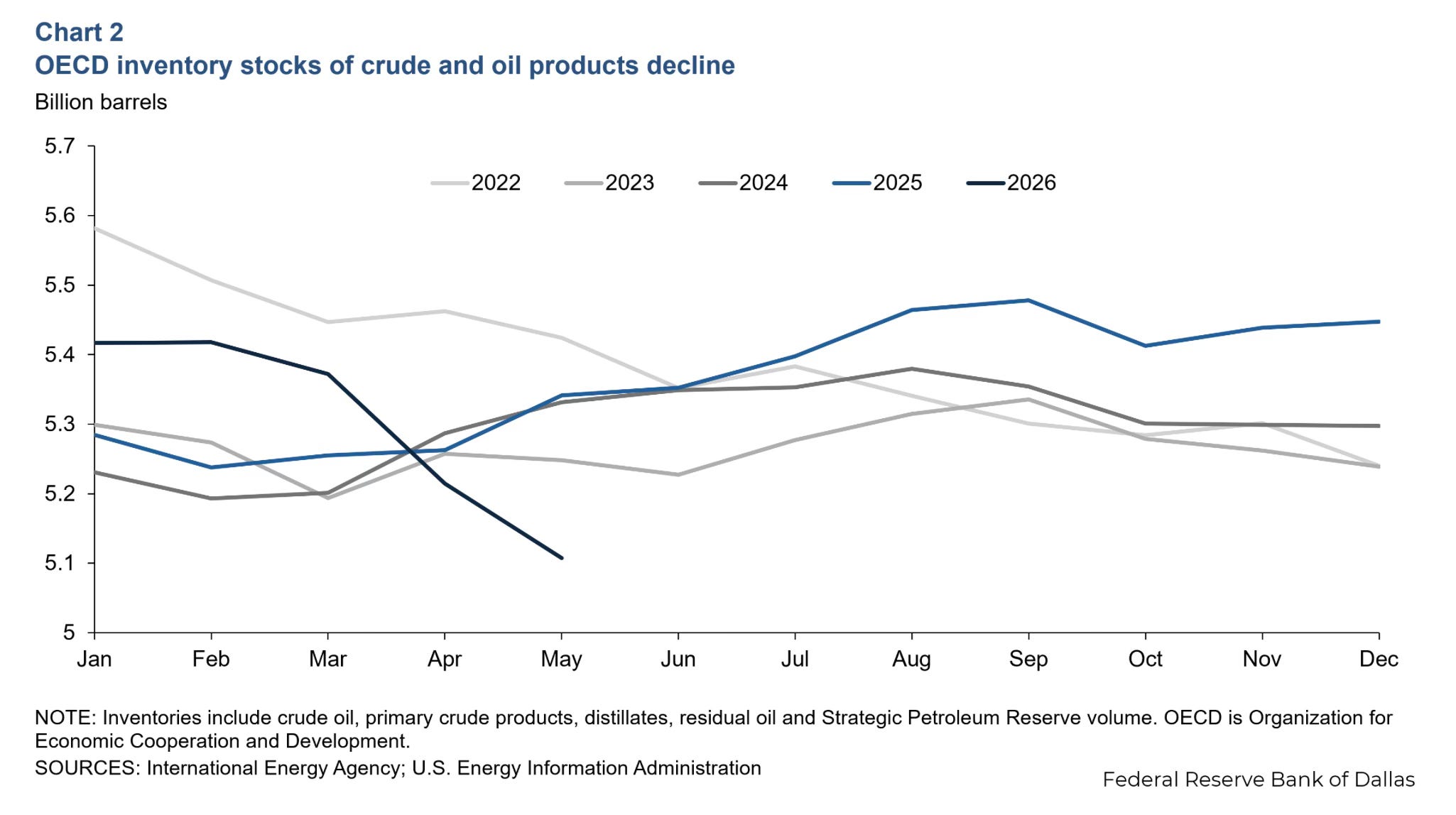
● Low crude oil inventories tied to the Strait of Hormuz and Red Sea situation.
● Producer concern over lasting damage to energy infrastructure — a drag on efficient oil/gas flow.
● Pipeline workarounds in progress: one route to the Red Sea (bypassing the Strait) estimated complete 2030; a UAE route estimated complete 2027; other bypass routes still TBD.
● 2026 inventory data (Jan–May) shows a clear drag versus historical norms.
Takeaways
Input costs remain elevated and tied to the Middle East conflict, with effects on fuel and materials still working through the system — the full pass-through may not have happened yet. Manufacturing is split, with durables outperforming non-durables (partly AI infrastructure build-out driven). Consumers remain resilient but nervous about prices, and elevated oil creates broader tension.
The US has weathered $100 oil before, but what the “new normal” looks like post-conflict is unclear — any real change will take months to show up. Energy activity remains measured, since producers answer to shareholders and need reasonable returns.
A Wall Street Journal piece noted Tehran’s reduced ability to move goods through the Strait, reflecting real economic stress on Iran. My. take: the Strait’s importance is ultimately secondary to relationships. The Canada-US trade war isn’t helping either, potentially hurting in both prices and jobs outlooks.
Closing Thoughts
Looking ahead: futures pricing a month ago (near $80) didn’t hold given renewed conflict, and volatility is likely to continue before prices moderate. This has no long-term economic upside, and the conflict’s geopolitics weighs on global growth broadly — the US has been more resilient than others, but that won’t last indefinitely, and it’s a dynamic voters are sensing. Inflation is likely to be a key issue heading into the vote, with volatility persisting until then — hopefully giving way to more policy normalcy afterward.